Australian Federal Budget 2026–27 and the Residential and Commercial Painting industry
National Painting and Decorating Institute | 26 May 2026
Summary
The 2026–27 Federal Budget is broadly supportive for the Australian painting industry, although the effects are uneven across different sectors. The strongest positives are housing infrastructure funding, support for new housing supply, simplified building regulation, small-business tax relief, and skilled migration reforms. These measures are likely to lift demand for residential new-build painting, public-sector repainting, commercial maintenance, and infrastructure-related protective coatings over the next 12–24 months.
The industry is already a significant employer. IBISWorld estimates Painting and Decorating Services revenue at approximately $9.6 billion in 2026, with around 55,873 people employed across 23,984 businesses. Jobs and Skills Australia separately estimates around 50,000 Painting Trades Workers employed nationally.
Key Budget Measures Affecting Painting Demand
| Budget measure | Expected impact on painting industry | Quantitative effect |
|---|---|---|
|
Housing Support Program – Local Infrastructure Fund
|
Positive for new-housing painting | $2.0 billion over 4 years; supports up to 65,000 homes over 10 years |
|
Faster approvals and simplified building regulation
|
Positive for builders, painters and small contractors | Free mandatory standards may save small firms/tradies up to $1,600 per year |
|
Negative gearing and CGT reform
|
Mixed: weaker established investor demand, stronger tilt to new builds | Estimated 75,000 extra owner-occupiers over a decade |
|
100,000 Homes for First Home Buyers program
|
Positive for new residential painting | $326.1 million grant component in 2026–27; up to 100,000 homes by 2034 |
|
Small-business tax changes
|
Positive for cash flow, equipment purchases and margins | Permanent $20,000 instant asset write-off from 1 July 2026 |
| Skills recognition reforms | Positive for labour supply | $85.2 million to speed migrant trade skills assessments and licensing |
Residential Painting Outlook
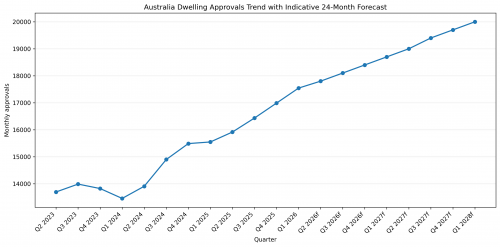
Residential painting is likely to remain resilient, particularly in repainting, renovation and maintenance work. ABS data show dwelling approvals fell sharply from the 2021 peak, with trend approvals declining from 20,714 in March 2021 to 13,404 in February 2024. By March 2026, trend approvals had recovered to 17,657, although seasonally adjusted approvals fell 10.5% in that month.
This means new-housing painting is improving from a weak base rather than entering a boom. The Budget’s housing measures should increase demand, but the strongest uplift is more likely in the 12–24 month period than immediately. Residential repaints should be steadier because homeowners continue to maintain and upgrade existing properties even when new-home approvals are subdued.
Chart 1: Indicative dwelling approvals trend and forecast
Commercial and Infrastructure Painting Outlook
Commercial and public-sector painting should strengthen over the next two years. Infrastructure Australia’s 2025 Market Capacity Report identifies a five-year Major Public Infrastructure Pipeline of approximately $242 billion from 2024–25 to 2028–29. Within that, buildings account for around $77 billion, including social housing, health facilities, schools, public buildings and other assets requiring interior coatings, exterior coatings, maintenance repainting and protective coatings.
Public infrastructure is particularly important for commercial painters because it creates demand beyond private office construction. Hospitals, schools, transport buildings, community facilities, social housing and government assets all require painting during construction and ongoing maintenance. This should support commercial repainting and maintenance contractors even if parts of the private commercial property market remain cautious.
Employment and Skills Outlook
Employment prospects for painters should improve moderately. The Budget’s housing and infrastructure measures support demand, while skills-recognition reforms may help increase trade labour supply. However, the sector is still dominated by small businesses and subcontracting crews, so labour shortages may continue where major projects compete with residential and maintenance work.
Apprenticeship and skilled migration settings will be important. If housing approvals recover and public building work expands at the same time, employers may need more apprentices, qualified tradespeople, supervisors, estimators and project managers. Painting businesses that can retain skilled staff, train apprentices and invest in productivity will be better placed to benefit from the Budget measures.
Indicative Revenue Mix
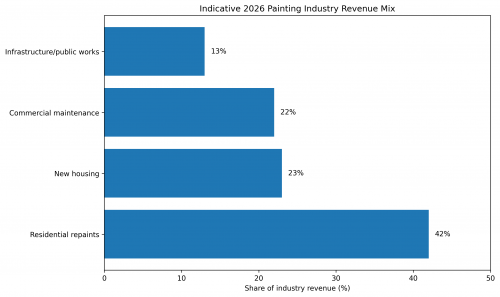
No official ABS or Budget source publishes a current national painting revenue split by sector. The following chart is an indicative estimate based on the estimated $9.6 billion painting industry size, housing renovation data, public infrastructure pipeline information, and construction-sector trends.
Chart 2: Indicative 2026 painting industry revenue mix
Conclusion
The 2026–27 Federal Budget is mildly positive for the Australian painting industry. Residential repaints should remain the most stable segment, new-housing painting should gradually improve as supply measures take effect, and commercial/public-sector painting should benefit from infrastructure and public-building pipelines. The main constraints are still housing approval volatility, labour availability, construction costs and project delivery delays.
Overall, the next 24 months point to a two-speed outlook: steady repaint and maintenance work in the short term, followed by stronger new-housing and public-building demand as Budget measures flow through the construction pipeline.
Sources
- Australian Government Budget 2026–27: Budget Paper No. 1, Budget Paper No. 2 and Budget Paper No. 3
- Australian Bureau of Statistics: Building Approvals, Australia
- IBISWorld: Painting and Decorating Services in Australia
- Jobs and Skills Australia: Painting Trades Workers occupation profile
- Infrastructure Australia: 2025 Market Capacity Report
- Housing Industry Association: housing approvals and renovation market commentary
- NCVER: Apprentices and trainees data